I built a campaigning wiki — and it's not finished yet
A few weeks ago someone asked me how to set up a dilemma action. I wanted to refer to a good source — and didn't have one. Once again not.
A few weeks ago, someone asked me how to set up a dilemma action. I wanted to point them to a good source — and had none. Again.
This has happened to me often in thirty years of campaigning: the knowledge of our craft is scattered — in people’s heads, old slide decks, in the colleague who happens to remember that one campaign. Anyone starting fresh starts almost from zero. That has always bothered me.
So I started bringing it all to one place: campaigning.wiki.
What it is
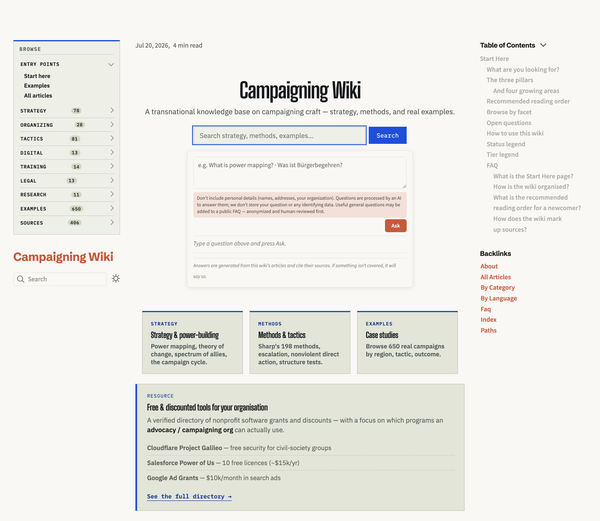
A field manual for organizers. A distilled, cross-linked library on campaign strategy, organizing, tactics, and digital craft — with worked-through case studies and a source behind every claim. Four pillars — Strategy, Organizing, Tactics, Digital — plus the legal framework around them.
Current status: 227 English concept pages, 386 sources, 642 case studies — from Fridays for Future to the 1995 French strikes to the Protestas Nacionales in Chile. Four languages are maintained in the tree (DE, FR, ES, IT), the live version is currently EN-only — translations are being re-synced as soon as the final source updates are done.
You can enter by your role — six hubs, from Tactician through Strategist, Manager, Comms, Coalition to Generalist. Or you can just ask the thing in plain language: Ask the Wiki searches the wiki (BM25), the LLM formulates the answer, every statement is backed by a [[wikilink]]. If nothing in the wiki covers the question, it says so honestly — instead of hallucinating.
Four curation tiers sort the material by trustworthiness: Core, Verify-then-use, Reference, Deprioritize. If you’re searching quickly, you fish only from Core; if you want to dig deep, you see everything and can check where it comes from.
How I built it
Distilled from real sources, with LLMs — but against a hard rule: no claim without evidence. Every factual sentence ends with a [source: …] marker, every marker has raw text in the background (RAW/), and a page only gets status: established if it can show grounding: primary plus a verified: date. That is an anti-hallucination guarantee, not a promise — an ungrounded page is held back by the publish gate, not delivered.
The whole thing ran as a 27-prompt pack in one repo: Foundation (Scaffold, Seed, Concepts, Ingest, Compile, QC-Gate, Publish) and Post-Launch (AskWiki, Multilingual, Tests, Feedback, Votes, E-Mail). Each step with its own check. Today it’s 93 build and audit scripts, 119 unit tests, six Playwright suites. License: CC BY-SA 4.0 — Credit “Campaigning Wiki”, link back, same license for derivatives.
The honest part
It’s an MVP. 83 stubs are honest stubs — the cited source is thin, paywalled, or not yet retrieved. Better a gap than fake depth. Some methods are still missing, a few hubs are thin, a cross-link or two is open. The other languages are in progress but not live yet.
I’m showing it anyway. Deliberately. Now. Unfinished.
Why? Because something like this only gets better when it’s used. I could tinker in a quiet room for another six months — or I show it to you, and you tell me what’s missing, what’s wrong, what you searched for and didn’t find.
That’s exactly my request. Go up, click around, and if something catches your eye: feedback form in the footer, upvote or downvote individual pages, or write directly to administrator@kampaspace.ch. Every tip makes it sharper.
Legal note upfront: Nothing in the wiki is legal advice. The pages on assembly law, data protection, or political activity rules for NGOs are general information, with jurisdiction and date — a starting point for your own research, not a substitute for a lawyer in your country.
👉 campaigning.wiki
Transparency note: This post was created with partial use of AI tools (including OpenAI, DeepSeek, and GLM/Z.ai for distillation, AskWiki responses, translations, and fact-checking). All content was carefully reviewed, revised, and approved by me. The statements in the wiki itself are backed by the grounding: primary standard — no claim without a source, no marker without raw text in the background.