A cockroach beat a cabinet minister. Here's the campaigning playbook.
India's satirical Cockroach Janta Party went from a six-word joke to a cabinet minister's resignation in 36 days — no party, no money, no seats. Seven transferable lessons for campaigners and organisers.

On 16 May 2026, a 30-year-old comms strategist named Abhijeet Dipke posted six words on X: “What if all cockroaches came together?” Thirty-six days later, India’s Education Minister resigned.
No party registration. No seats. No war chest. One person, a website built overnight with AI tools, and a slur reclaimed as a brand. If you run campaigns, this is one of the cleanest natural experiments you’ll get to study for a while — a movement that went from a joke to a cabinet resignation in ten weeks, in full public view.
So let’s do the useful thing and take it apart. Not “wasn’t that wild,” but: what actually transferred pressure into an outcome, and which of it you could steal.
The setup, in one paragraph
India’s Chief Justice, in open court, called unemployed youth “cockroaches” and “parasites.” That landed on top of a real grievance: a leaked national medical-entrance exam (NEET) that was cancelled and forced two million exhausted students to sit it again — with a cluster of student suicides in the weeks that followed. Dipke turned the insult into a party name that parodies the ruling Bharatiya Janata Party — swap “Bharatiya” for “Cockroach” — and invited everyone the system had written off to sign up. Within a week the Instagram account passed 20 million followers, more than the BJP’s or Congress’s official accounts. Six weeks after that, the minister was gone.
Here’s why it worked.
1. They picked a name the government couldn’t attack
This is the sharpest strategic move in the whole story, and it’s the one most people miss.
Governments crush protests with a standard playbook: label the movement anti-national, foreign-funded, elite, fringe — split it into pieces you can pick off. That playbook needs a target it can make other. The Cockroach Party pre-empted it. As the cultural critic Anurag Minus Verma put it, the protesters had already identified themselves ridiculously enough — they’re cockroaches — so the usual method of splitting them into sections and demonising them simply had nothing to grab. You can’t shame someone who has already made “lazy, unemployed, chronically online” their official membership criteria.

The insult became the brand — a mascot that’s impossible to stamp out. Photo: Cecep Rahmat / Unsplash (illustrative).
The lesson: reclaiming a slur isn’t just cheeky branding. It’s delegitimisation-proofing. It’s the same reason Tory, Quaker, Suffragette and Queer all started as insults. If your opponent’s main weapon is a label, take the label away by wearing it first. The insult also handed them the entire brand for free — the logo, the hashtag (#MainBhiCockroach, “I too am a cockroach”), the founding myth.
2. Irony did work that earnest messaging can’t
The membership form was a joke: unemployed “by force, by choice, or by principle,” lazy “physically only — the brain may continue to spiral,” online “at least 11 hours a day, including bathroom breaks.” The manifesto sat right next to it, dead serious.
That combination is the engine. Humour travels — an ironic post outruns an earnest one every time on a feed. But more importantly, humour was the generation’s actual coping mechanism for a system that had failed them, and shared jokes are what turned scattered frustration into a single identity. The comedy wasn’t decoration on the message. The comedy was the recruitment mechanism.
The lesson: if your cause is heavy, the tone doesn’t have to be. A self-deprecating frame lowers the cost of joining (you’re signing up to a joke, not a barricade) and raises the cost of attacking (mock the joke and you look humourless and cruel). Just make sure the serious ask is sitting right there next to the gag, or you’ve built a meme, not a movement.
3. Every attempt to shut them down made them bigger
The government blocked their X account under the IT Act. The account was back under a new handle — “Cockroach is Back” — within minutes, because the movement lived on eight platforms at once (X, Instagram, Reddit, Discord, Telegram, WhatsApp, YouTube, Facebook). Then Dipke took the block to the Delhi High Court and won — turning an act of censorship into a multi-week free-speech news cycle with a court victory at the end.
Later, police forcibly hospitalised a 59-year-old ally on hunger strike, and baton-charged the march on Parliament. Both times, the crackdown produced a bigger mobilisation than the thing it suppressed. The march the next day was larger precisely because people were furious about the hospitalisation.
The lesson: build platform redundancy before you need it, so a takedown is an inconvenience, not a decapitation. And understand the Streisand dynamic — a repressive opponent is a co-organiser if you’re positioned to catch the backlash. That positioning is a choice: nonviolent, sympathetic, visibly disciplined. Which brings us to the next one.
4. They out-produced the state’s own media game
When the police cracked down, officials denied using excessive force. It didn’t matter — the feeds were already flooded with student-shot video: a baton on a woman’s back, a mother pleading with officers, students tripped as they fled tear gas. One 18-year-old’s line became the movement’s thesis: they were televising their revolution.

Frozen out of sympathetic TV, they routed around it — thousands of phones as a newsroom the state couldn’t block. Photo: Kevin Woblick / Unsplash (illustrative).
They’d been frozen out of sympathetic TV coverage — what protesters call “godi media,” the pro-government press — so they routed around it entirely. Thousands of phones became a distributed newsroom the state couldn’t block, buy, or intimidate.
The lesson: you no longer need the gatekeepers to hold the mic, but you do need to organise the coverage. Distributed documentation only works as counter-media if people know to film, know what to film, and have somewhere to send it fast. Treat your own crowd as your press corps and brief them like one.
5. The demand was narrow enough to win
The manifesto was sprawling and radical — judicial reform, 50% women’s reservation, breaking up media conglomerates. But the campaign asked for one concrete, winnable thing: the Education Minister’s resignation over the exam scandal.
That’s the difference between a movement and a mood. A cabinet minister can resign. “Fix the education system” cannot be conceded, so it can never be won. By naming a specific person and a specific failure, they gave the government a pressure-release valve — and gave themselves a clean, dateable victory.
The lesson: keep the vision big and the ask small and specific. You want a demand your target can actually say yes to, so that pressure has somewhere to go. One resignation is a headline. A whole worldview is a wish.
6. They climbed an escalation ladder, in order
They didn’t start with a march on Parliament. They started with volunteers in cockroach costumes doing neighbourhood clean-ups. Then city rallies. Then an indefinite sit-in at Jantar Mantar — bodies on the ground, round the clock, for weeks. Then hunger strikes, grafting the oldest Gandhian tactic in the Indian repertoire onto internet-native branding. Only then, the march.
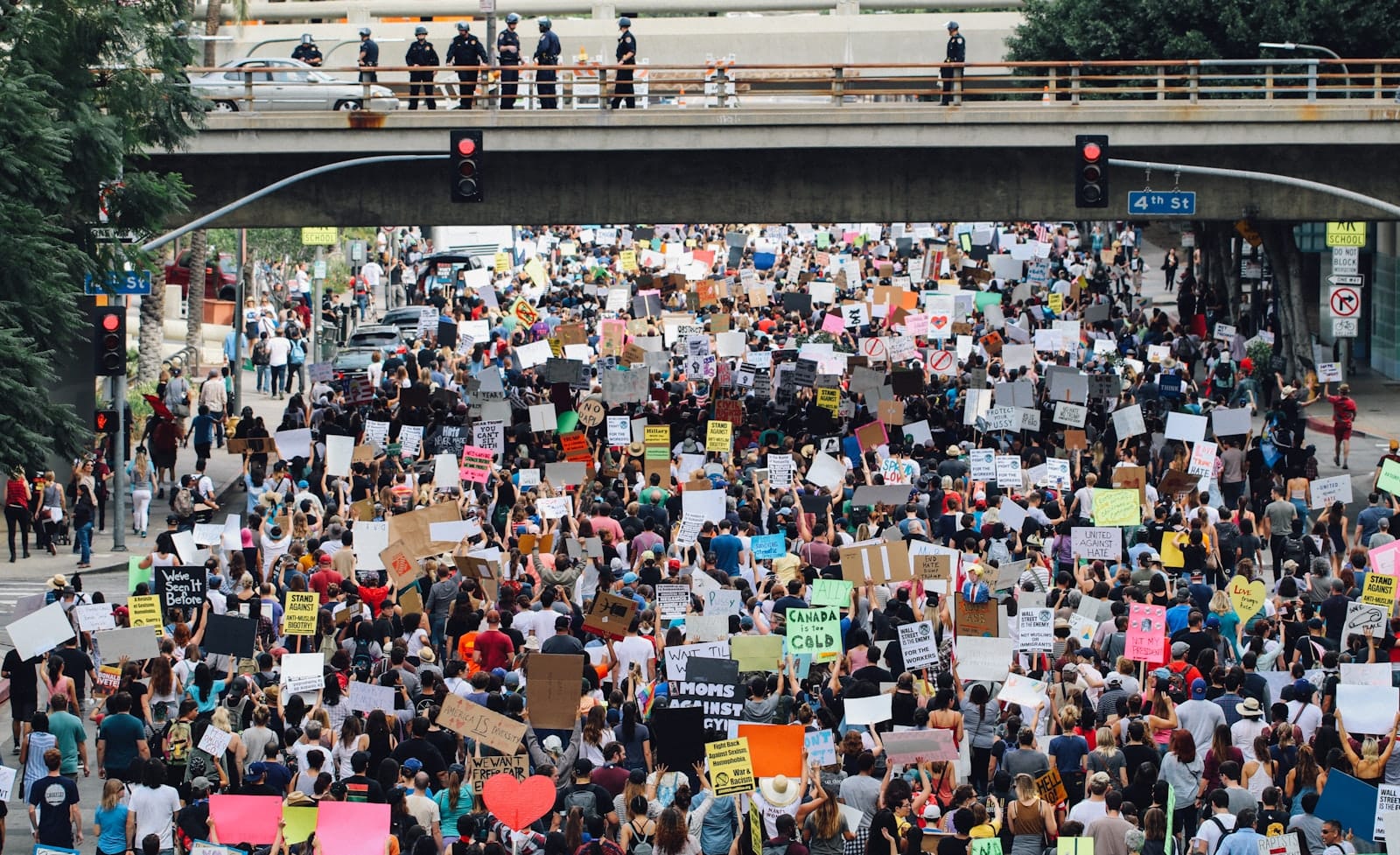
The hardest problem in digital organising: turning followers into bodies on the street. Photo: Alex Radelich / Unsplash (illustrative).
Each rung did something the last couldn’t: the clean-ups made the joke tangible and safe to join, the sit-in converted followers into a physical presence you could photograph, the hunger strikes manufactured moral stakes, the march forced the confrontation. This is the answer to the hardest problem in digital organising — 22 million followers, but can you get anyone to show up? A mid-June critique nailed the movement for exactly this: “reach without weight,” huge online numbers, a few thousand bodies per city. Then 20 July happened and tens of thousands marched. The ladder is how you close that gap: you don’t ask the couch to storm Parliament on day one.
The lesson: sequence your tactics from low-commitment and low-risk to high. Every rung should convert a cheaper form of support into a costlier one, and give people who joined the joke a reason — and a safe next step — to become people who show up.
7. Staying out of party politics was the strategy
Dipke kept refusing to register as a party or let existing politicians co-opt the movement — he invited all parties to the protests, but under the national flag, not their own. That refusal preserved the one asset a viral movement has that established parties don’t: the credible claim that it isn’t one of them. The moment you’re “the youth wing of Party X,” half your crowd remembers why they don’t trust Party X.
The lesson: independence is a resource, and it’s spent the instant you accept the wrong endorsement. Sometimes the highest-leverage move is the alliance you publicly decline.
What “won” actually means here — and the honest caveats
Be precise about the win, because it’s easy to oversell. They forced a cabinet minister out and extracted concessions on compensation and dropped cases. They won no election and hold no seat. Whether this becomes durable power or fades as a viral moment is genuinely unknown — and serious analysts, including academics quoted throughout the coverage, caution it may be the latter.
A few more things a good campaigner should hold honestly:
- Follower counts are self-reported and contested (figures range from 20 to 26 million across sources). Online scale is not the same as organised power — the movement itself nearly proved that in June before the July escalation.
- The founding insult may have been narrower than the movement claimed. The Chief Justice said within a day he meant fake-degree holders, not youth broadly. The whole premise rests on the broad reading. That tension never resolved.
- The government’s framing wasn’t an apology. The minister’s resignation letter cast it as protecting students from “anti-national forces,” not as owning the exam failures. Concessions announced are not concessions delivered.
- Foreign-funding and “49% Pakistani followers” claims were made by ministers and independently debunked — a reminder that the delegitimisation playbook still ran, it just didn’t land.
And one thing that isn’t a campaigning tactic at all: this movement is inseparable from a cluster of student deaths driven by a broken, high-stakes exam system. The lesson there isn’t a lesson. It’s the reason the anger was real, and it deserves to be named as a systemic failure rather than mined for narrative.
The one-line takeaway
A movement with no money, no party, and no institutional power still moved a government — because it chose a frame its opponent couldn’t attack, made joining cheap and attacking costly, built for repression instead of hoping to avoid it, and asked for one thing it could actually win.
None of that required 22 million followers. It required 22 million followers plus a plan for what to do with them. That second part is the whole job.
This post was created with partial use of AI tools (including for fact-checking) such as Gemini, Perplexity and Manus. All content has been carefully reviewed, revised and is my own responsibility. This is a fast-moving, recent story; figures and outcomes were accurate to the reporting available at the time of writing. Header image is an original CampaignPulse graphic; inline photos are illustrative stock, not images of the movement.