The bus says «Authiis». What can actually be changed about a wrong announcement.
A synthetic voice mispronounces my village's name on the bus. Before assigning blame, the sober question is what can actually be changed — and who decides.

A synthetic voice mispronounces my village's name on the bus. Before assigning blame, the sober question is what can actually be changed about such an announcement — and who decides.
I grew up in Amden. I've ridden the stretch between Weesen and Amden countless times — awake, half-asleep, in every possible state. I know every stop blind; from the turn-in of the front axle alone I know where we are. All the more, the new voice stands out, the one that has recently been announcing the stops. “Weesen, Authiis,” it says. Aathüs, our Aathüs, turned into “Authiis.” And it stresses “Amden” on the second syllable, as if the village lay in some country nobody knows.
I could have written an angry post. Foreign tech, mangling our names, typical. Instead I asked myself what can actually be changed about such an announcement. That question leads to a solution faster than any outrage.
What a synthetic voice can do — and what stays open
Modern speech synthesis can, in principle, control pronunciation and stress. The W3C standard SSML describes phoneme markup, lexicons and prosody for exactly this. But that doesn't mean every platform offers the same functions — and certainly not that they're available or enabled in the on-board or passenger-information system of line 650. Whether and how “Amden” can be corrected there would have to be confirmed by the operator or its system supplier.
The relationship to the rest of the data is open too. If pronunciation is maintained in a separate speech or lexicon layer, a correction might be possible without touching the official stop and timetable data. That's a technical and contractual question, not a given.
There's a well-known reference case, but it too serves only as a hint, not proof. In 2024, Nau.ch reported on the criticised pronunciation of “Etoy”; the SBB said at the time it would review the feedback and make corrections where necessary. Whether and how that happened, the report doesn't say.
Who could change it — the actually open question
The Autobetrieb Weesen–Amden describes itself as a licensed transport company and as an operation of the municipality (Ortsgemeinde) of Amden; according to the AWA, the concession for the Ziegelbrücke–Weesen–Amden–Arvenbüel route lies with the municipality. But no exclusive authority over voice, language or phonetics follows from that.
The AWA is an obvious first point of contact. Whether the change is implemented by the operator itself, by a system supplier, a data partner or in a coordinated process, the AWA should clarify transparently.
Thanks to the comments under the post, it became visible which companies are presumably behind the system — the on-board-computer specialist Atron Group and, for software and data management, BOS Software. For line 650 this isn't confirmed. But both are proven specialists for exactly this kind of passenger-information and announcement system, and they almost certainly know how a pronunciation can be corrected. My guess, therefore, is that the problem is less technical than banal. Presumably nobody simply wants to pay for it. That's exactly where one could start — and both companies are warmly invited to show how easy it is.
That's where the transferable insight lies, and it reaches beyond buses. A large part of the frustration with “systems” comes from guessing where the lever is instead of knowing it. Who decides, and by what process, is the first question of any campaign — and the one people most like to skip.
Why I'm not ranting
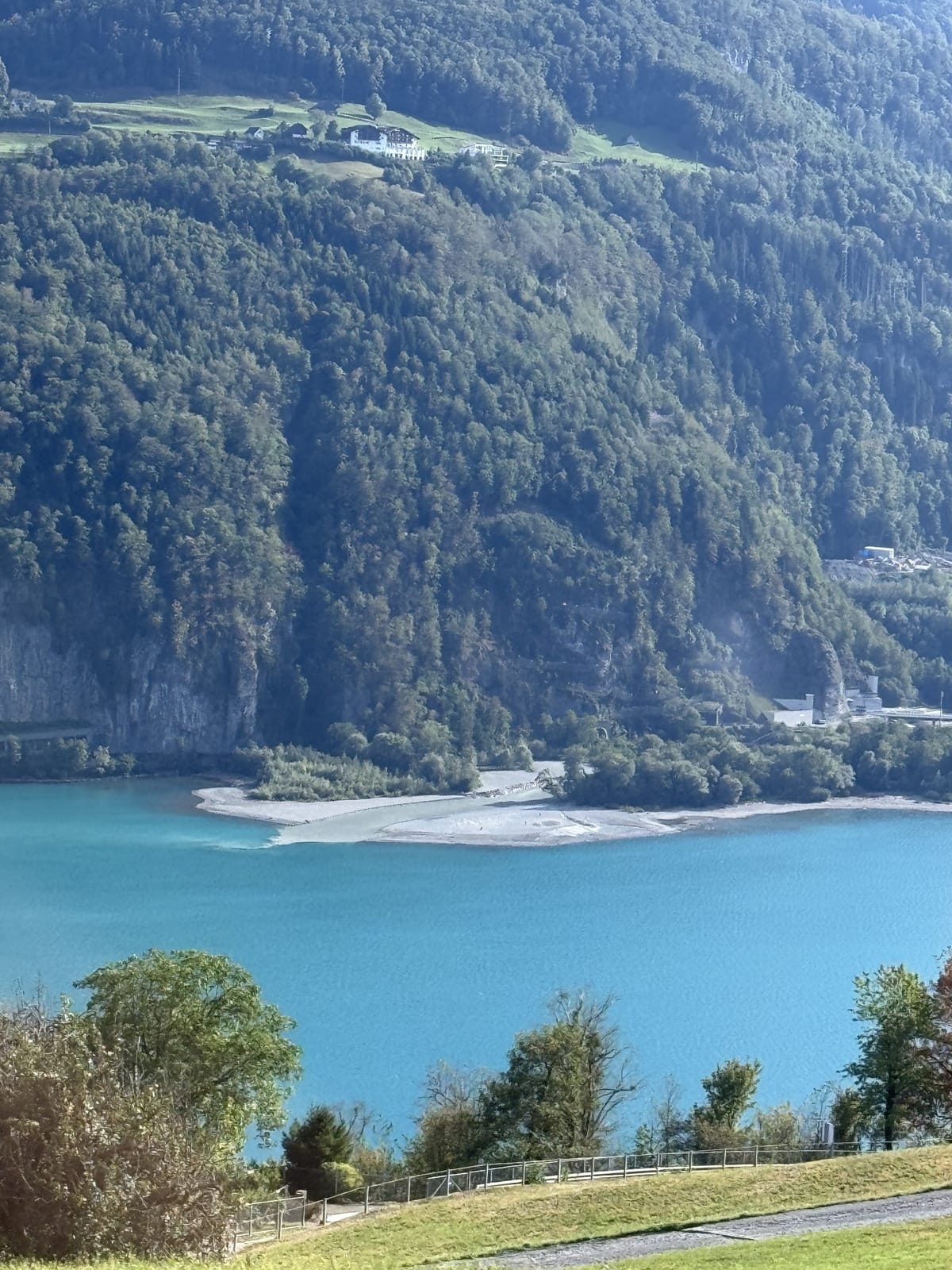
I wrote a personal post yesterday. Not a letter, not a complaint — an open, friendly appeal to replace the announcements with real voices from the village, perhaps with a little contest, ending in a female and a male voice from Amden and Weesen. Plus a picture of Lake Walen from the ride and the offer to help organise it.
The public appeal on Facebook resonated — around 110 reactions, 19 comments and 5 shares, with broad support. Michael von der Heide, for one, wrote “Of course I'd be in!” (as of 24 Aug 2026). And something is now moving. I'm also in contact with Tourismus Weesen Amden; the organisation wants to raise the matter with the bus operator. Nothing is done yet. But that's how it starts — someone with a line to the operator picks up the thread.
Tone decides. I want to get something moving here, not make anyone look bad. A shitstorm makes people defensive, an offer makes them curious — and the companies behind such a system have their own interest in it sounding better.
The core
We don't have to accept supposedly unchangeable digital systems. But before you assign blame, you clarify the responsible body, the process and the approval path.
If you want to get something like this going, a sober approach helps — as a practical recommendation, not a guaranteed fix:
- Document. A short audio recording with line, stop, date and time.
- Ask. Politely ask the operator for information on the system, responsibility and correction procedure.
- Offer. If useful, a locally checked pronunciation list or technical help.
What this means for you
For anyone who wants to change something, there's more here than a bus anecdote. Don't take digital systems as fate, but don't rush to assign technical blame either. First research the actual decision path, then offer a constructive solution. Constructive opens doors that a wave of outrage slams shut — and it keeps you clean if your first guess turns out wrong.
Nothing is achieved yet. This story started yesterday, and whether the voice will one day stress “Amden” on the first syllable, I don't know. Maybe that's exactly the better start — not with an accusation, but with an open question and an offer. If you have an idea what's still missing and how best to tackle it, write it in the comments.
Transparency & sources
The technical cause, the system architecture, possible suppliers, the internal responsibility, and the effort and cost of a correction are not established and would have to be verified with the AWA. What is secured is my own observation on the ride and my contact with the local bodies (as of 24 Aug 2026).
- W3C, Speech Synthesis Markup Language (SSML) 1.1 — w3.org
- Autobetrieb Weesen–Amden, imprint — awa-bus.ch
- Swiss Federal Office of Transport, concessions — bav.admin.ch
- BAV stop list (Open Data Platform Mobility Switzerland) — opentransportdata.swiss
- Nau.ch, report on “Etoy”, 9 February 2024 — nau.ch
- The original appeal on Facebook (reactions, comments, endorsements; as of 24 Aug 2026) — facebook.com
This post was created with partial use of AI tools (including for fact-checking). All content has been carefully reviewed, revised and is my own responsibility.