
Like many others, I’m constantly discovering new AI tools. Each one promises to be better, faster, or more intelligent. After an intensive period of using Perplexity, I stumbled upon Manus sometime last year—an AI orchestrator that had the potential to fundamentally change the way I worked. Manus wasn’t just another AI tool. It was a promise. A promise of autonomy, of comprehensive task management, of a new era of artificial intelligence. But this fascination was abruptly interrupted.
About three weeks ago, a newsletter from Manus landed in my inbox, proudly presenting impressive growth figures. Just a week later came the real bombshell: Manus now belongs to Meta. A quick search confirmed the unbelievable news: After only nine months of live operation, the startup was swallowed up by Mark Zuckerberg’s corporation for an estimated 2 to 2.5 billion US dollars. And suddenly I’m faced with a choice that goes far beyond simply preferring a digital tool.
The short, steep climb from Manus
To understand my dilemma, you have to understand what made Manus so special. Founded by a trio of Chinese tech specialists—Xiao Hong, Ji Yichao, and Zhang Tao—Manus was more than just a chatbot. It was the self-proclaimed “world’s first fully autonomous general AI agent.” While tools like ChatGPT rely on step-by-step instructions, Manus could independently break down complex tasks into smaller steps, create a plan, and execute it in an isolated cloud environment. It could screen resumes, rank applicants, format data, and perform stock analyses—all with minimal human interaction.
The numbers spoke for themselves: In just eight months after its launch in March 2025, Manus achieved an annualized revenue (ARR) of $100 million. By comparison, the popular AI code editor Cursor took 18 months to reach that level. Manus wasn’t just hype; it was a viable business model that attracted professional users willing to pay for real efficiency gains.
AI Orchestration vs. Agentic AI: What Manus was really capable of
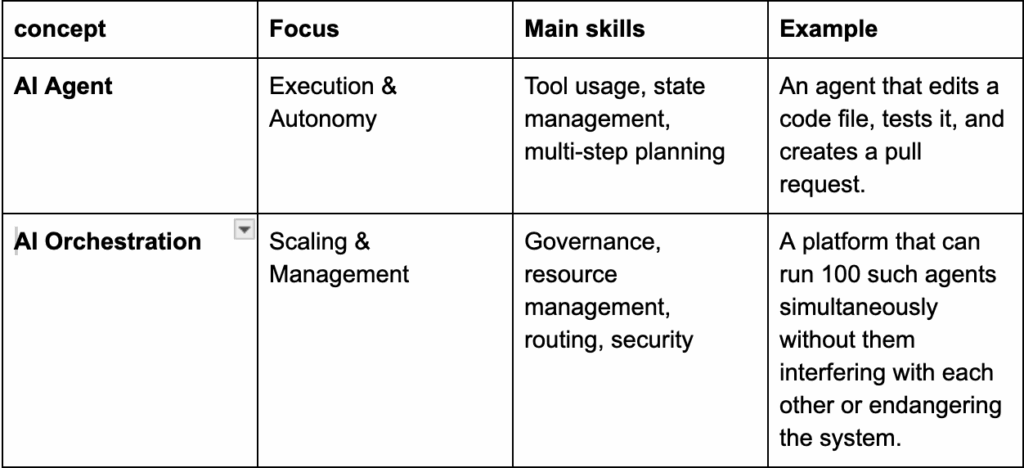
The secret behind Manus’ abilities lies in the combination of two concepts that are often confused:AI Agent and AI Orchestration.
Let’s imagine it in layers:
- The Language Model (LLM):At the very bottom sits the raw AI model, such as GPT-4 or Claude 3.5. It is the brain that can think but not act.
- AI Agent:This layer gives the brain a physical form. It enables the model to use tools (e.g., execute code, browse the internet), remember past actions, and autonomously pursue a goal over several steps. An AI agent is a system that perceives, thinks, acts, and learns from the results.
- AI Orchestration:This is the infrastructure that manages an entire army of agents. It handles security (sandboxing), resource allocation (computing power, API limits), and task distribution to the right agent. Orchestration becomes crucial when scaling from a single agent on a laptop to hundreds of agents in the cloud.
Manus was both a powerful agent and a clever orchestrator. It utilized a multi-agent architecture where specialized agents worked together for planning, execution, and verification. This ability to orchestrate the best available AI models for a given task and allow them to act autonomously made Manus so superior.
Why Meta is paying 2 billion for a 9-month-old start-up
For Meta, Manus is the perfect complement. While Meta’s own llama models are world-class brains, they lacked the body – the ability to act. Manus provides precisely this “action engine”.
Mark Zuckerberg’s vision of a “personal superintelligence” requires more than just chatbots. He wants AI to act for us. Integrating Manus into WhatsApp, Instagram, and Facebook could enable these platforms to move from passive content consumption to active task management. Imagine asking your AI in WhatsApp to book a vacation, and it simply does it. That’s the future Meta is trying to buy with Manus.
The acquisition also has a geopolitical dimension. Manus’ Chinese roots and early investors like Tencent could have posed a problem in the US. But the team was forward-thinking: Moving the headquarters to Singapore in June 2025 was a strategic move that paved the way for the Meta deal. Meta has already clarified that no Chinese ownership interests will remain after the acquisition.
My dilemma: Convenience vs. conscience
And here I am. Should I continue using this brilliant tool and thereby make Mark Zuckerberg even richer and more powerful? Or should I look for alternatives that may not (yet) be quite as good, but are not part of a tech giant whose business model I view critically?
It’s the classic question of convenience versus conscience. Meta will undoubtedly make Manus even more powerful. Integration with existing platforms will be seamless. But the price is a further centralization of power and data in the hands of a single corporation.
I’ve started looking for alternatives. There are exciting projects like OpenHands, which focuses on agentic AI for software development, but it’s not (yet) the comprehensive orchestration platform that Manus was. There are countless open-source projects that show promise, but often require technical expertise and don’t offer the same ease of use.
Ideally, I’d like an even better tool that’s even cheaper and wouldn’t make Mark Zuckerberg any richer, but preferably poorer. But the reality is that building and operating such complex AI systems requires enormous resources – resources that are often only available to the big tech companies.
A call to the community
This story is more than just a personal anecdote. It’s emblematic of the evolution of the internet and AI. We stand at a crossroads. Will we opt for a few, extremely powerful, but closed ecosystems? Or will there be room for a diverse landscape of independent, perhaps more specialized, but more open tools?
I don’t have a definitive answer. But I know I’m not alone in this dilemma. That’s why I’m turning to you, the community of campaigners, tech enthusiasts, and critical thinkers. What tools do you use? What alternatives to the major platforms have you discovered? How do you navigate the tension between technological fascination and ethical responsibility?
Share your thoughts in the comments. Let’s create a map of alternatives together. Because the future of AI is too important to leave to the giants alone.
Disclaimer: This article was created with the partial assistance of AI tools (for research and fact-checking). All content has been carefully reviewed, revised, and approved.