

The letter from Army Chief Thomas Süssli on Microsoft dependency is one of the most interesting statements made by the Swiss Army in recent years. The letter, which has now been made public, has caused quite a stir, with articles appearing in all of Switzerland’s major media outlets. His initiative, which opposes the federal administration’s almost complete dependence on Microsoft, is more than just a footnote. It is a wake-up call that we should all heed – from the boardroom to the IT department to each and every one of us who works with these tools on a daily basis.
I therefore took some time over the weekend to take a closer look at the best alternatives to Microsoft and who is already using them. This is the topic of my Campaign Pulse newsletter today.
The problem has a name: CLOUD Act
The debate is not new, but it is becoming more heated. The core of the problem lies in the lack of digital sovereignty. The problems are called the CLOUD Act, FISA Section 702 and Executive Order 12333: these three US legal instruments allow American authorities and intelligence services to access our data – even if it is physically stored in Swiss data centres. The CLOUD Act obliges US companies to hand over data, FISA Section 702 allows the surveillance of non-US citizens without a court order, and Executive Order 12333 authorises comprehensive foreign surveillance without judicial control. This risk affects us all and is being negligently ignored by the Federal Chancellery, which continues to adhere to the migration roadmap. Microsoft, Amazon Web Services (AWS) and Google Cloud must comply with this law.
Army Chief Süssli sums it up: around 90 per cent of all data held by the Swiss Armed Forces is classified as ‘internal’ or ‘secret’. Processing this data on a US cloud is not only negligent, but also prohibited under the federal government’s confidentiality guidelines. The Federal Chancellery (BK) seems to be ignoring this so far and is sticking to its migration roadmap. This approach leaves not only me, but also many experts speechless.
‘I am amazed that no one in the federal government has raised this issue before,’ says Matthias Stürmer, professor at the Bern University of Applied Sciences, Technology and Computer Science and expert on digital sovereignty, in the Tages-Anzeiger newspaper.
The danger is real. Imagine if, in an emergency, the US government could pull the plug or access sensitive negotiation documents. The idea alone is a nightmare for any sovereign nation, but also for any critical NGO and for many competing companies.
There are alternatives – and they are better than their reputation
The good news is that there are alternatives. There is a growing number of independent, mostly European and often open-source alternatives that are not only more secure but also catching up technologically. The excuse ‘there is no alternative’ no longer counts.
I have taken the trouble to research the most important alternatives and compile a ranking list. This is intended as a guide for anyone looking for ways out of dependency.
The ranking list of independent cloud alternatives
This ranking is based on a combination of functionality, security, sovereignty, prevalence and proven success in practice.
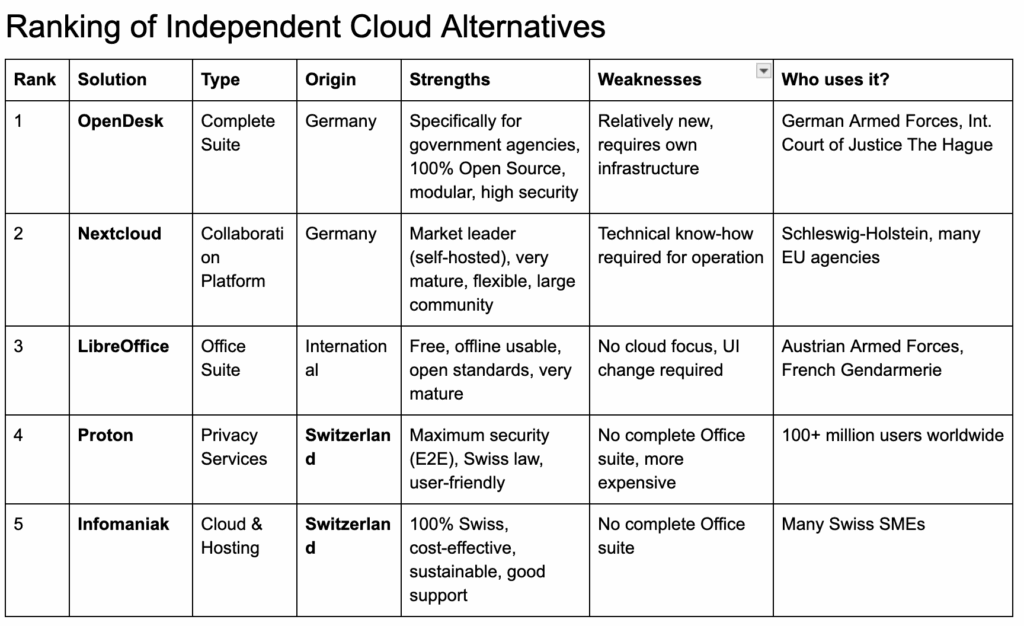
Conclusion: Sovereignty comes at a price, but dependence costs more
The transition is no walk in the park. It requires investment, training and the (political) will to take digital sovereignty seriously. But the costs of dependency are much higher: loss of control, the constant threat of espionage and the growing financial burden of licence fees, which Microsoft & Co. can increase at will. The army alone expects additional costs of 4.6 million Swiss francs per year.
Countries such as Denmark, the German states of Schleswig-Holstein and Thuringia, and the Austrian Armed Forces are leading the way. They have the courage to break new ground and rely on open source solutions. It is time for Switzerland to follow suit.
The letter from Army Chief Süssli is an opportunity that we must not let slip by. It is an opportunity for a long-overdue public debate about the digital future of our country. A future in which we retain control over our data.
What do you think about this? Does your organisation already use alternatives, or are you deeply entrenched in the Microsoft world? I look forward to reading your thoughts and experiences in the comments.
Best wishes for your Monday morning, I wish you a good week.
Andi Freimüller
Sources
[1] Blick (31 October 2025): Resistance to Microsoft: Army chief does not trust the Americans. Available online at: https://www.blick.ch/politik/widerstand-gegen-microsoft-armeechef-traut-den-amis-nicht-id21378341.html
[2] Tages-Anzeiger (1 November 2025): Because of Trump and high costs: Swiss army wants to move away from Microsoft. Available online at: https://www.tagesanzeiger.ch/thomas-suessli-fordert-schweizer-armee-weg-von-microsoft-108051050766
[3] Republik (31 October 2025): Army chief opposes Microsoft. Available online at: https://www.republik.ch/2025/10/31/der-armeechef-stemmt-sich-gegen-microsoft
[4] openDesk (2025): The office and collaboration suite for public administration. Available online at: https://www.opendesk.eu/en
[5] Nextcloud (2025): Nextcloud for Government. Available online at: https://nextcloud.com/government/
[6] Xelon (2025): Top 7 Swiss Cloud Providers as Alternatives to Microsoft Azure. Available online at: https://www.xelon.ch/en/blog/das-sind-die-7-besten-cloud-alternativen-zu-microsoft-azure
Transparency note: This article was created using AI tools such as Gemini, Perplexity and Manus. All content has been carefully checked, revised and verified by me.